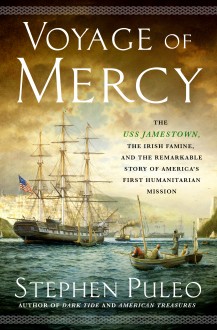
The USS Jamestown, the Irish Famine, and the Remarkable Story of America’s First Humanitarian Mission
In his latest book, Voyage of Mercy, author and historian Stephen Puleo details the remarkable story of the mission that inspired America to donate massive relief to Ireland during the potato famine, which sparked America’s tradition of providing humanitarian aid around the world.
More than 5,000 ships left Ireland during the great potato famine in the late 1840s, transporting the starving and the destitute away from their stricken homeland. The first vessel to sail in the other direction, to help the millions unable to escape, was the USS Jamestown, a converted warship, which left Boston in March 1847 loaded with precious food for Ireland.
Captain Robert Bennet Forbes and the crew of the USS Jamestown began a massive eighteen-month demonstration of soaring goodwill against the backdrop of unfathomable despair—one nation’s struggle to survive, and another’s effort to provide a lifeline. Forbes’ undertaking inspired a nationwide outpouring of relief that was unprecedented in size and scope, the first instance of an entire nation extending a hand to a foreign neighbor for purely humanitarian reasons. It showed the world that national generosity and brotherhood were not signs of weakness, but displays of quiet strength and moral certitude.
Through July 1848, some sixteen months after the assistance began, Americans donated a massive amount of food, more than 9,900 tons, to sustain Ireland. The humanitarian transatlantic convoy from the United States that began with Jamestown’s unprecedented voyage did not stop until upwards of 150 ships from U.S. ports delivered food, clothing, and provisions to starving Ireland.
Voyage of Mercy tells the incredible story of the famine, the Jamestown voyage, and the commitment of thousands of ordinary Americans to offer relief to Ireland, a groundswell that provided the collaborative blueprint for future relief efforts, and established the United States as the leader in international aid.
Reviews
Excerpts
Discussion Questions
Buy Voyage of Mercy
More
Reviews
The Wall Street Journal
Voyage of Mercy Review: America’s Great Gift to Ireland
By Terry Golway
In 1847 Congress ordered that the U.S. warship Jamestown be outfitted to bring much-needed emergency aid from Boston to Ireland at the height of the island’s potato famine.
Americans have grown accustomed to seeing their fellow citizens providing food, medicine and logistical assistance at disaster sites around the globe. It’s not by any means an exceptionally American tradition, but a tradition it surely is.
Some might argue that it began a century ago, when a brilliant engineer named Herbert Hoover organized humanitarian aid to feed millions of starving, homeless Europeans during and after World War I. But according to Stephen Puleo, the nation’s impulse to aid the afflicted beyond its borders can be traced to the journey of a warship bound from Boston to Ireland at the height of the island’s potato famine. Its mission was not conquest but relief, for in its hold were 8,000 barrels of food donated by the young republic 3,000 miles away from Ireland’s misery.
The potato failures in Ireland in the late 1840s and early 1850s are well-known and little understood, at least on this side of the Atlantic. In “Voyage of Mercy,” Mr. Puleo joins a long list of historians and writers who have sought to explain why and how so many Irish people died when the potato failed. Easy to cultivate and filled with nutrition, the potato was their staple crop, but when it turned black and putrid, they had nowhere to turn. There was plenty of food in Ireland, but much of it was designated for export, and, as Mr. Puleo notes, Victorian policy makers in London were not about to question the wisdom of laissez-faire economics. So Irish people died of disease and starvation while food was loaded aboard ships bound for other markets.
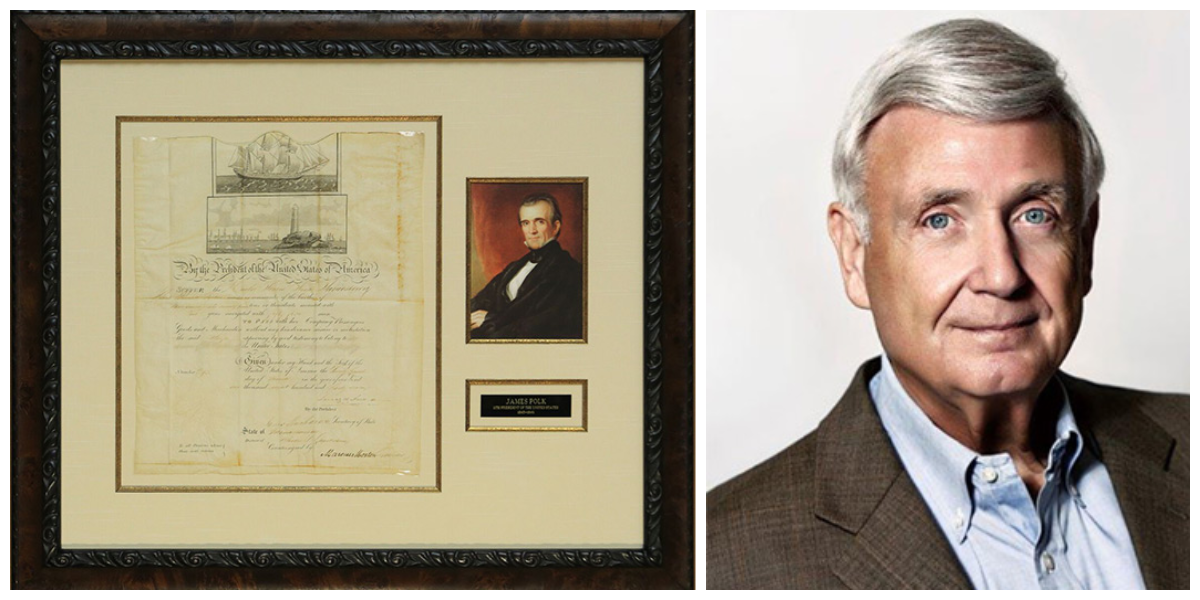
As Americans learned of the horrors in Ireland, they responded on a scale that would become familiar in the decades to come. President James K. Polk, the legendary orator Daniel Webster, and the great compromiser Henry Clay delivered impassioned appeals for action on behalf of the Irish. “It is not fervid eloquence, nor gilded words, that Ireland needs—but substantial food,” Clay said.
Shortly thereafter, the U.S.S. Jamestown was pulled from active duty in order to transport food and clothing to Ireland. An armada of relief followed in its wake, becoming “the single greatest philanthropic effort by one nation on behalf of another,” in Mr. Puleo’s words.
There is no shortage of scholarship on the subject of Ireland’s suffering from roughly 1845 to 1851. Recent books by Christine Kinealy, John Kelly and Enda Delaney, among others, have broadened our understanding of what happened in Ireland more than 150 years ago and why the failure of a single crop led to death and exile on a gigantic scale, transforming not only Ireland but the U.S. as well. But Mr. Puleo has found a new way to tell the story with this well-researched and splendidly written chronicle of the Jamestown, its captain, and an Irish priest who ministered to the starving in Cork city.
Robert Bennet Forbes had no family connection to Ireland, but after hearing of the distress in Ireland during a mass meeting in Boston in 1847, he offered a daring proposal: The U.S. should make a warship available to bring aid to Ireland as quickly as possible, and he—a veteran sea captain—would command it. It took an act of Congress to achieve, but it was done, thanks in large part to the advocacy of Sen. John Crittenden of Kentucky.
The Jamestown was retrofitted for its new mission and set sail for County Cork in March 1847. Waiting there was the Rev. Theobald Mathew, renowned then and now as Ireland’s apostle of temperance. The priest put aside his crusade against drink to minister to the starving and the dying as they poured into Cork city in search of something to eat. He saw horrors similar to those that a British administrator witnessed when he stumbled upon, as he put it, “six famished and ghastly skeletons, to all appearances dead . . . huddled in a corner on some filthy straw.” They were not dead but perhaps wished they were, for they were in the final throes of hunger-related disease.
The arrival of the Jamestown and the ensuing partnership between the American sea captain and the famous Irish priest is the dramatic high point of Mr. Puleo’s book. But other narrative threads are equally vivid. As the Jamestown’s cargo is unloaded, for instance, Mr. Puleo shifts to a scene that would not surprise even casual students of Irish history: There was a split among the Irish over whether the Jamestown’s relief should be distributed in rural areas throughout County Cork, one of the hardest-hit regions, or restricted to Cork city. Capt. Forbes was forced to intercede, and he decided that the supplies were intended for the whole county. Thus started another American tradition—mediating Ireland’s disputes—upheld, to take one prominent example, by former Maine Sen. George Mitchell, who helped broker Northern Ireland’s Good Friday Agreement in 1998.
Mr. Puleo correctly sees the voyage of the Jamestown as a seminal moment in the history of American-Irish relations. While British authorities worried that the starving Irish would become dependent on charity, Capt. Forbes and other Americans delivered relief, no questions asked. “An Irishman looks on America as the refuge of his race,” wrote novelist Thomas Colley Grattan, a Dubliner.
But it wasn’t quite so simple, as Mr. Puleo points out. American benevolence shriveled up when the starving Irish landed in New York, Boston and other U.S. cities. Few would have predicted that two of those wretched exiles would start a family in Boston that would one day produce a president and two U.S. senators. Yes, those Kennedys.
Mr. Puleo’s tale, despite the hardship to come, surely is a tribute to the better angels of America’s nature, and in that sense, it couldn’t be more timely.
Read the full Voyage of Mercy review here by Dean Jobb, author of Empire of Deception and non-fiction writing teacher at the University of King’s College in Halifax, Nova Scotia.
Shelf Awareness
History
Voyage of Mercy: The USS Jamestown, the Irish Famine, and the Remarkable Story of America’s First Humanitarian Mission by Stephen Puleo
As historian Stephen Puleo (American Treasures) points out in Voyage of Mercy: The USS Jamestown, the Irish Famine, and the Remarkable Story of America’s First Humanitarian Mission, the repercussions of the Irish famine of the 1840s still linger. Broad swaths of American society are descendants of the countless Irish people who fled their homeland during the devastation. English-Irish relations were poisoned for decades, because of the appalling decision of the English leadership to allow thousands of Irish people to starve to death while continuing to force Irish farmers to export their crops to England to meet quotas.
As the potato blight tore apart Irish society, and the English turned a blind eye, the Americans came to the rescue. Spurred by cries for aid from such illustrious statesmen as Daniel Webster and Henry Clay, the American populace donated generously. The Jamestown was fitted as a relief ship, and Captain Robert Bennet Forbes was commissioned to undertake the voyage to Ireland with his hold full of supplies, which, in a “happy coincidence,” were loaded aboard the Jamestown on St. Patrick’s Day, 1847.
Having overcome terrible tragedies in his own life, Forbes was determined to help alleviate the suffering of the Irish. His journey not only marked a pivotal point in American history, but it also laid the groundwork for “the collaborative public-private blueprint… that has guided America’s international charitable relief for more than a century and a half.”
In this meticulously researched, yet eminently approachable book, Stephen Puleo provides a fascinating glimpse at a little-known facet of a well-known trauma. –Jessica Howard, bookseller at Bookmans, Tucson, Ariz.
Discover: An enthralling history of the Irish famine and the United States’ first humanitarian project: sending a ship of supplies to help alleviate Irish suffering.
IrishCentral
New book tells the incredible story of the first American ship to bring Famine relief to Ireland
By Niall O’Dowd
An invaluable new book shines light on the untold story of the first ship that left America and sailed to Ireland laden with food to help the starving Irish during the Famine.
The successful mission of mercy inspired thousands of other Americans to donate and pay for ships to bring food. It was also the first American humanitarian mission sending aid from one country to another.
5,000 ships left Ireland during the Famine. The USS Jamestown captained by Robert Bennet Forbes was the first ship to go the other way.
Forbes, a merchant and man of intense compassion, made it his life mission to help the starving Irish after observing so many desperate Irish arrive in Boston.
The book also portrays the amazing work of a Cork-based Irish priest Father Mathew, famous for his work on stopping alcohol abuse, whose role in ministering to and saving thousands of Irish during the famine has never been properly revealed.
Excerpted from the New York Post
The 15 best books to read in our age of social isolation
By Mackenzie Dawson
Stuck in your house or apartment for the foreseeable future? Coincidentally enough, so am I. I’ve loved reading for most of my life; it calms me down when things feel crazy and chaotic (now, for example), pushes me to think about circumstances outside of my own life, and allows me to travel in my mind when real travel isn’t an option (see: now). You might even say that books are the original social-distancing tool.
Here’s my roundup of 15 books to read during these shutdown days — a combination of thrillers, relationship dramas, action-packed page-turners, and everything in between. Only two of my picks are nonfiction, chosen because they celebrate the best that humanity is capable of; the rest are fiction, because let’s face it — these days we could all use a bit of an escape from reality. Happy reading.
Voyage of Mercy: The USS Jamestown, the Irish Famine, and the Remarkable Story of America’s First Humanitarian Mission
Thousands of ships left Ireland during the Potato Famine in the 1840s, packed with poor and starving crowds fleeing their homeland for the promise of the United States. One ship, the USS Jamestown, headed from Boston in the other direction, loaded with food for the Irish. It was the first humanitarian mission by the United States — prior to it, the idea of nations helping each other was not considered — and it set the precedent for many more such efforts to come. A moving historic tribute.
Kirkus Reviews: “An uplifting historical account of humanitarianism with lessons in this increasingly isolationist time”
Kirkus Reviews, one of the preeminent reviewers in the book industry, offered a favorable pre-publication review of Voyage of Mercy. Kirkus said Steve’s seventh book “focuses on a remarkable event in 1847 to illuminate a broader discussion about U.S. aid to other nations.” The review added: “The author effectively shows how ‘the events of 1847 have served as the blueprint and inspiration for hundreds of American charitable relief efforts since, philanthropic endeavors that have established the United States as the leader in international aid in total dollars.’ An uplifting historical account of humanitarianism with lessons in this increasingly isolationist time.”
Read the full Kirkus review here.
Booklist gives Voyage of Mercy a “starred review”
Voyage of Mercy received a “starred review” from Booklist, a publication of the American Library Association that provides critical reviews of books; its primary audience consists of libraries, educators, and booksellers. The Booklist star indicates an outstanding title of a particular genre. As Booklist said:
“The American impulse to do humanitarian good dates back almost two centuries to the 1847 sailing of the USS Jamestown. Congress ordered this warship’s guns removed, transferred the three-masted vessel into private hands, loaded it with food and clothing, and sent it from Boston to Cork, Ireland for relief from the devastation of the Irish potato famine. Puleo (American Treasures, 2016) makes this history compelling, and tells further American aid stories across the decades through the Berlin Airlift of 1948. Puleo’s deep research is evident in an erudite bibliographic essay.”
Other Authors offer praise for Voyage of Mercy
“Voyage of Mercy is a fascinating and moving tale of America as we wish it would always be—kind, generous, and humane to people who are in dire need of help, wherever they may live. Puleo is a master storyteller who seamlessly weaves together the personal and the political in this enthralling narrative of the United States’ philanthropic and humanitarian roots. In today’s fractious and divisive world, this book is a tonic to the soul, and a potent reminder that we are at our best when we follow the ‘better angels of our nature’.”
- Eric Jay Dolin, author of Black Flags, Blue Waters and Leviathan
“Voyage of Mercy is why we read. It’s history as it should be written. It reads like a terrific, page-turning novel, with characters who live and breathe and struggle and yearn, with grand dramatic moments, with settings so vividly described in a world so impeccably researched that you think you’re there, with powerful themes that will resonate long after you’ve finished reading. It’s Stephen Puleo’s best book and a voyage that every reader should take.”
- William Martin, New York Times bestselling author of Back Bay and Bound for Gold
Voyage of Mercy Reviews from Goodreads
Read if you: Think a heartbreaking, moving, and inspirational account of the Irish famine and the USA’s first major international humanitarian program sounds up your alley. Ireland’s potato famine changed Ireland and the United States forever. Not just in terms of the many lives lost, but also in terms of the massive immigration of Irish men and women to the United States (where they faced enormous prejudices), the deepening of Ireland’s hatred of England, and the mobilization of the United States’s first international aid program, which became a blueprint of sorts for later massive aid programs, including the food drops in Berlin shortly after World War II. This is almost unbearably sad at times (particularly with Captain Forbes’s many personal losses), but you will remember this long after finishing it.
Voyage of Mercy is a non-fiction accounting of the humanitarian aid the US sent to Ireland during the famine in 1846. Mr. Puleo has pored through historical documents to bring us this bittersweet story. He introduces us to the key players, with plenty of background of who they were, why they took the actions they did, and we get a view of their lives. He has the facts and figures which he presents in a way that is interesting and furthers the story…Many Americans can be proud of how our ancestors responded [to the Irish famine]. The USS Jamestown was a retrofitted battleship on the first international humanitarian mission. People from across the US gave food, money, clothing and other supplies to be taken to Ireland in the hopes that it would relieve suffering. Up to this point, such action was seen as weak, but these people didn’t care, they knew they lived in a bountiful land, and wanted to save lives. Thanks to #NetGalley for allowing me to review #VoyageofMercy and give my honest opinion, it was a very good book!!
With meticulous research, documentation, and presentation the author presents the conditions of that harsh winter of 1847-48 with no food, no heat, no roof, scant clothing or shoes, and precious little hope…There is incredible detailing of the life histories of the major players and a whole lot more, but the undercurrent is the need by individuals in the US to do whatever they can whenever they feel that they can make a difference, regardless of nationality.
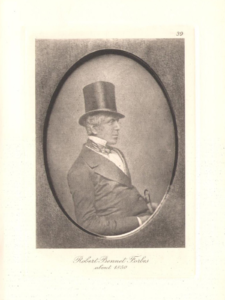
Portrait of Captain Robert Bennet Forbes.
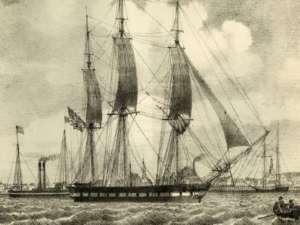
The Departure of the USS Jamestown from Boston to Ireland in 1847.
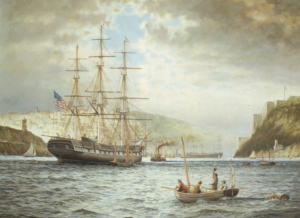
The USS Jamestown arrives in Ireland.
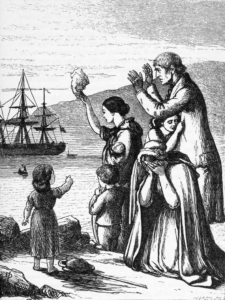
Emigrants leaving Ireland for North America as they fled the famine.
About Steve
Stephen Puleo is an author, historian, teacher, public speaker, and communications professional. He has published eight narrative history books, taught college-level history courses, made more than 740 speaking appearances, and created writing workshops for both students and adults.
Email Steve at spuleo@aol.com.