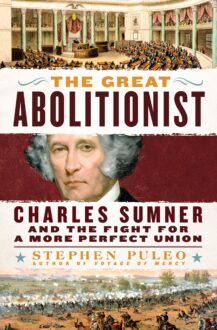
Charles Sumner and the Fight for a More Perfect Union
The Great Abolitionist is the first major biography of Charles Sumner to be published in over fifty years. It tells the story of one of the most influential non-presidents in American history (included in this exclusive club were Benjamin Franklin, Alexander Hamilton, Susan B. Anthony, and Martin Luther King, Jr.) – and far more influential than many presidents – a leader who exhibited true courage and authenticity.
In the tempestuous mid-nineteenth century, as slavery consumed congressional debate and America careened toward civil war and split apart – when the very future of the nation hung in the balance – Charles Sumner’s voice rang strongest, bravest, and most unwavering.
Where others preached compromise and moderation, he denounced slavery’s evils to all who would listen and demanded that it be wiped out of existence. More than any other person of his era, he blazed the trail on the country’s long, uneven, and ongoing journey toward realizing its full promise to become a more perfect union.
Before and during the Civil War, at great personal sacrifice – which included enduring a vicious beating that nearly killed him – Sumner was the conscience of the North and the most influential politician fighting for abolition. Throughout Reconstruction, no one championed the rights of emancipated people more than he did.
To Sumner, the two concepts of abolitionism and equal rights were inseparable and could not be untethered. Freedom and equality embodied the founding principles of the United States as stated in the Declaration of Independence, and in the Constitution’s guarantee of a republican form of government. Only by enshrining these rights forever could the United States survive.
This view was first considered radical and unworkable, dismissed as the ranting of rabble-rousers on the fringe – positions at first not held even by Lincoln and other anti-slavery Republicans. But Sumner’s influence gradually took hold, permeated the party’s dogma, and finally became the prevalent and official view of Lincoln and the nation.
Through the force of his words and his will, he moved America toward the twin goals of abolitionism and equal rights, which he fought for literally until the day he died. He laid the cornerstone arguments that civil rights advocates would build upon over the next century as the country strove to achieve equality among the races.
Reviews
Excerpts
Discussion Questions
Buy The Great Abolitionist
More
Reviews
Reviews for The Great Abolitionist
Kirkus Reviews (“Starred” Review)
See full Kirkus review here (Excerpt) “Puleo’s vast knowledge of 19th-century Boston and its diffident attitude toward slavery and integration—due in no small part to textile merchants and financiers who relied on Southern cotton for their prosperity—adds tremendous value to his account of Sumner’s transformation from depressed and sullen Harvard-educated lawyer to uncompromising and unrelenting civil rights champion, orator, and senator…[The Great Abolitionist is] required reading for anyone with even a slight interest in Civil War–era U.S. history. A wonderfully written book about a true American freedom fighter.”
Publishers Weekly (“Starred Review”)
Read the full Publishers Weekly review (Excerpt) “Readers won’t be able to get enough of Puleo’s indomitable Sumner.”
South Carolina Post & Courier
Written by Rosemary Michaud, this review called The Great Abolitionist “a vivid, eloquent biography of Senator Charles Sumner…richly sourced, informative and eminently readable.” I thank Michaud for saying, “Puleo is an excellent writer, at times as eloquent as the subject of this study.” To make the review readable for you without having to navigate the paper’s paywall, it’s included here as a PDF link.
American Purpose
Harvard Law student and contributing editor, Tom Koenig, wrote a thoughtful and outstanding review for American Purpose magazine. Koenig called The Great Abolitionist a “masterful new biography” of Sumner and really captures the essence of the book in his thorough review. Link to the full American Purpose Review here.
Tim Talbot in Emerging Civil War
Read the full review here (Excerpt) “Puleo skillfully covers Charles Sumner’s extensive efforts and accomplishments on behalf of racial equality – before, during, and after the Civil War…The Great Abolitionist is a welcome addition to the abolitionist historiography. Updating Sumner’s biography with sources and interpretations that have emerged since Dr. [David] Donald’s two-volumes a half century ago clarifies and reemphasizes Sumner’s importance to American politics during the nation’s most trying era.”
Unabridged Bookstore
Read the full review here (Excerpt) “this compelling, rich, biographical history bears witness to Sumner’s profound contributions to creating a more perfect union, and is essential reading for anyone interested in the Civil War and Reconstruction.”
History Nerds
Read the full review here (Excerpt) “The Great Abolitionist is a wonderful biography of a man who had an unassailable passion for abolition but probably would not be the first person you’d invite to a dinner.”
Dennis Lehane, author of Small Mercies: “Stephen Puleo’s masterful account of Charles Sumner, a prickly, conflicted paradox of an American giant, is told with verve and gusto. It’s a vibrant, important story whose echoes still reverberate in our current day. A wonderful read.”
James M. O’Toole, University Historian and Clough Professor of History Emeritus at Boston College: “Charles Sumner, a lifelong crusader for human rights, has not been the subject of a comprehensive biography for more than fifty years. Stephen Puleo fills that gap with this deeply researched and dramatic retelling of Sumner’s courageous life and work.”
William Martin, New York Times bestselling author of The Lincoln Letter and December ’41: “Sometimes, a giant needs a little help. He passes through history, leaving huge footprints that are filled by time and covered over by events. Well, in Stephen Puleo’s superb new biography, Massachusetts Abolitionist Charles Sumner gets all the help he needs. In prose that is perceptive and propulsive, in scenes that are powerful and dramatic, Puleo brings Sumner vividly to life. Once more, The Great Abolitionist drives the momentous events of the mid-Nineteenth Century. Once more, the strength of his character, the intensity of his personality, and the honor of his crusade shine before us. And once more, Stephen Puleo delivers a book that will captivate the general reader and reward the serious historian, too.”
Gregg Olsen, New York Times and Amazon Charts bestselling author of The Amish Wife and If You Tell: “When it comes to impeccable research – the kind that surprises and never rehashes – no one does it better than Stephen Puleo. The Great Abolitionist is a literary and historical triumph and is sure to be on many year-end “best” lists in 2024.”
William J. Kole, veteran journalist, author of THE BIG 100: The New World of Super-Aging: “Nearly two centuries on, Charles Sumner’s name still drops loudly in Boston, yet few appreciate the enormity of his impact. Stephen Puleo’s The Great Abolitionist is at once a revelation and an appeal to our better angels to heed the lessons Sumner’s example can teach us.”
Eric Jay Dolin, author of Left for Dead and Black Flags, Blue Waters: “Charles Sumner was a principled man of unshakable conviction, who fought the good, noble, and heroic fight against slavery, and he deserves to be remembered as a great statesman and one of the foremost champions of civil rights. He also deserves a compelling and wonderfully-written biography, which is what Stephen Puleo has provided.”
Christopher C. Gorham, author of THE CONFIDANTE: The Untold Story of the Woman Who Helped Win WWII and Shape Modern America: “In THE GREAT ABOLITIONIST we feel the cold wind in the cobbled streets of mid -19th century Boston and hear the stifled sobs at Abraham Lincoln’s deathbed in April 1865. The subject of Stephen Puleo’s eighth book is Charles Sumner, a lawyer and U.S. Senator who was a leading voice of antislavery during the tumultuous two decades before the Civil War. As the nation was adding Texas, rushing west for gold, and vainly seeking a compromise on slavery to avoid war, Puleo paints Sumner’s morality as a constant. We are in the courtroom as he argues against the inherent inequality of segregated schools (a century before Brown v. Board of Education), and the drawing room as Sumner persuades the sixteenth president to publicly stand for abolition. Sumner’s ideals cost him friendships and resulted in a bloody assault on the floor of the senate by a pro-slavery congressman. Puleo’s rich biographical history is a perfectly timed reminder that to survive, our union needs figures with the courage to stand for core ideals which cannot be compromised.”
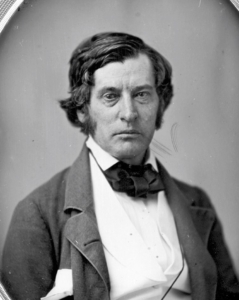
A daguerreotype of Charles Sumner taken in 1855
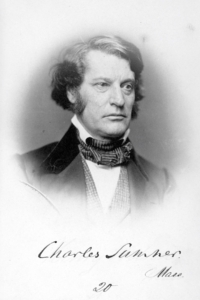
Charles Sumner photographed in 1859 for the 35th Congress
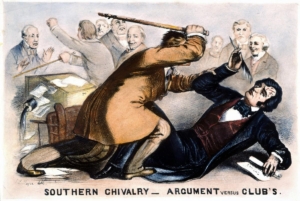
1856 artwork of Sumner's caning by South Carolina Congressman Preston Brooks, entitled "Southern Chivalry -- Argument versus Club's" [sic]. This became the classic depiction of Sumner's caning.
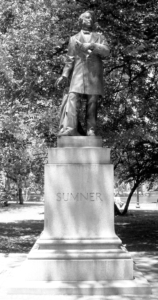
Statue depicting Charles Sumner in Boston's Public Garden.
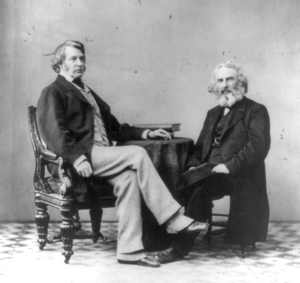
Longtime dear friends Charles Sumner and Henry Wadsworth Longfellow, photographed by Alexander Gardner.
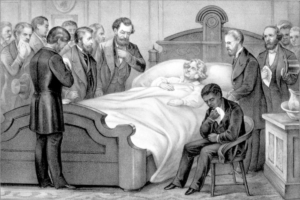
A Currier & Ives print of the death of Charles Sumner in 1874. His friend and former slave, Frederick Douglass, is shown in the foreground.
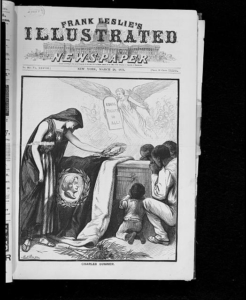
Illustration of Charles Sumner's casket by Matt Morgan, from Frank Leslie's Illustrated newspaper, 1874.
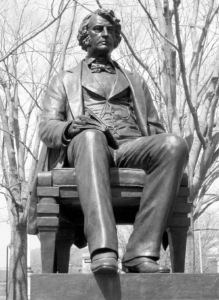
Statue depicting Charles Sumner on the campus of Harvard University.
About Steve
Stephen Puleo is an author, historian, teacher, public speaker, and communications professional. He has published eight narrative history books, taught college-level history courses, made more than 740 speaking appearances, and created writing workshops for both students and adults.
Email Steve at spuleo@aol.com.