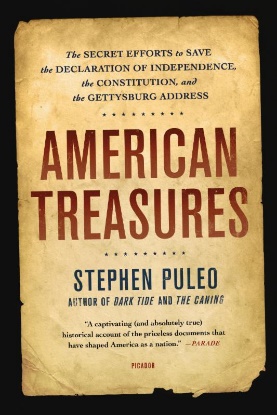
The Secret Efforts to Save the Declaration of Independence, the Constitution, and the Gettysburg Address
On December 26, 1941, Secret Service Agent Harry E. Neal stood on a platform at Washington’s Union Station, watching a train chug off into the dark and feeling at once relieved and inexorably anxious. These were dire times. Hitler’s armies were plowing across Europe, seizing or destroying the Continent’s historic artifacts at will, and three weeks earlier Japan unleashed its devastating attack on Pearl Harbor. American officials now feared an enemy attack on Washington, D.C.
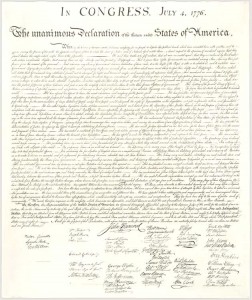
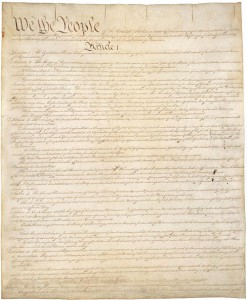
So, President Franklin D. Roosevelt set about hiding the country’s valuables. On the train speeding away from Neal sat four plain-wrapped cases containing the documentary history of America – including the Declaration of Independence, the Constitution, the Gettysburg Address – guarded by a battery of agents and bound for safekeeping in the nation’s most impenetrable hiding place.
American Treasures charts the creation and little-known journeys of these priceless American documents. From the risky and audacious adoption of the Declaration of Independence in 1776 to our modern Fourth of July celebrations, shows how the ideas captured in these documents underscore the nation’s strengths and hopes, and embody its fundamental values of liberty and equality.
Stephen Puleo weaves exciting stories of freedom under fire—from the smuggling of the Declaration and Constitution out of Washington days before the British burned the capital in 1814, to their covert relocation during WWII—crafting a sweeping history of a nation united to preserve its democracy and the values embodied in its founding documents.
Reviews
Excerpts
Discussion Questions
Buy American Treasures
More
Reviews
David S. Ferriero, Archivist of the United States:
“Stephen Puleo once again educates, enlightens, and entertains us, this time through the history of the most important documents of our democracy. A tour de force based on exhaustive research into both primary and secondary sources, he tells the miraculous stories of the survival of the most precious evidence of our freedom thanks to, until now, the unsung heroes and heroines of our past.”
Richard R. Beeman, Author of Plain Honest Men: The Making of the American Constitution:
“Stephen Puleo has written an extraordinary and truly innovative book on a subject on which hundreds of books have been written: the great American documents, most important among them the Declaration of Independence, the U.S. Constitution and the Gettysburg Address. Puleo weaves together the fascinating story of how the documents were created, how they came to be protected in times of national crisis, and how as a result they have become ever more priceless.”
William Martin, New York Times Bestselling Author of The Lost Constitution and The Lincoln Letter:
If you yearn for a book that sweeps you through time, forging fresh new connections between past and present while reinforcing universal truths about our national aspirations, read American Treasures. It’s a rich and resonant narrative history, surging with character and incident, the kind of book that you will devour for the depth and breadth of its erudition and, more simply, because it’s a terrific tale, told by a fine historian who also happens to write like a seasoned novelist.
Doug Most, Author of The Race Underground: Boston, New York, and the Incredible Rivalry That Built America’s First Subway:
“There are not many secrets left in our country’s storied history, and here Stephen Puleo has uncovered a true gem. American Treasures takes readers on an incredible journey filled with mystery and surprise. American Treasures is an American treasure.”
Kenneth C. Davis, Author Don’t Know Much About History, America’s Hidden History:
“Weaving together a riveting narrative of the effort to keep America’s founding documents safe from harm during World War II with a stirring recap of the origins of the Declaration, Constitution and other precious American treasures, this is a wonderful tale. Not only does Stephen Puleo recount the little-known heroics of Archibald MacLeish, the Librarian Congress, in a post Pearl Harbor climate of fear, he also reminds us of how these “Charters of Freedom” are what truly make America exceptional.”
Library Journal:
“An engrossing account of the creation, consecration, and conservation of the documents that defined American democracy. Readers will take away a new appreciation for the vision and savvy of government officials in finding ways to ensure such treasures would survive.”
Kirkus Reviews:
A novel perspective on American history that focuses on the story of the country’s founding documents and the Americans who composed, safeguarded, and preserved them for the benefit of future generations.
American History magazine contributor Puleo concentrates not on the drafting of the Declaration of Independence and other documents but rather their preservation. Near the beginning of World War II, Franklin Roosevelt had requested that Archibald MacLeish, Librarian of Congress, prepare a plan to safeguard the nation’s key founding documents. He feared that Hitler would bomb the capital city. MacLeish had to select the documents to protect as well as safe storage sites. That endeavor provides Puleo with a unique frame for a recounting of the history of the physical documents and their continued existence as well as the revered history of their creation. The author’s fast-moving presentation combines the familiar stories of their adoption and passage with those of their subsequent production and dissemination. The Declaration of Independence passed on July 2, not July 4, and the official signing didn’t take place until a month later. Only after four more months did all the names appear on the copy held by the printer. The author makes it clear not only how dangerous it was to be associated with those awe-inspiring documents, but also how threatened they were. Without the courageous initiative of Dolly Madison, for example, it is doubtful the treasures could have been saved from destruction in the fires set by the British during the War of 1812. The drafting and circumstances of delivery of Abraham Lincoln’s Gettysburg Address helps round out the picture. In addition to threats, anniversaries and celebrations continue to call forth efforts to preserve and protect these precious documents from enemies and the passage of time.
A solid retelling of an inspiring story.
The Patriot Ledger
By Jody Feinberg
Even trivia buffs may be surprised by this July 4 fact. The Declaration of Independence once was locked among the gold in Fort Knox, after the United States U.S. government secretly moved it and other founding documents from the Library of Congress. Fearful of an attack on Washington, D.C., after Pearl Harbor, the government also packed 5,000 boxes of historical papers into vans headed for university libraries.
The story of these extraordinary protection efforts is told in the book “American Treasures: The Secret Efforts to Save the Declaration of Independence, the Constitution and the Gettysburg Address,” which will be published August Aug. 30.
“I felt like I knew a lot about World War II, but had never heard of this,” said author Stephen Puleo of Weymouth, whose interest began after he came across a brief mention. “I wanted to understand this herculean effort.”
After the United States entered World War II, President Franklin Roosevelt, Library of Congress director Archibald MacLeish, the director of the Library of Congress, and Harry Neal, a top aide to the chief of the Secret Service, were determined to be proactive to protect these treasured documents. On Dec. 26, 1941, “four wrapped packages” traveled by overnight train and were locked the next day inside Fort Knox, Kentucky. The transfer of the 5,000 boxes of documents to the University of Virginia, Washington and Lee University and Denison College took place over about two months, packed into about 29 vans.
Remarkably, the moves remained secret until after the war, something Puleo suspects could not happen today.
To tell the story, Puleo researched not just the events of 1941 and 1942, but the creation of the Declaration of Independence, the Constitution and the Gettysburg Address, all now housed in the National Archives and Records Administration in Washington, D.C. His vivid and detailed descriptions of characters and events will make readers feel like they are in the room with historic figures.
“It became clear that the story really was about the documents themselves, what they meant to people and their motivations for protecting them,” said Puleo, author of five other history books. “No one else has told the story of the protection of the country’s big three documents as part of the overall story of American history.”
At this time of year, Puleo thinks more frequently about the Declaration of Independence. He will celebrate the day with his wife, Kate, principal of St. Jerome School in North Weymouth, and friends in New Hampshire.
“I’m a bit of a history evangelist,” said Puleo, who followed his passion at age 40 and earned a master’s degree in history at the University of Massachusetts, Boston.
Over the four years Puleo researched and wrote “American Treasures,” he worked in public relations and communication for a health care company and taught at Suffolk University. Like “American Treasures,” his previous book “The Caning” examined the significance of a single event in the context of the nation’s broader history.
“I love the research and writing and speaking to audiences and meeting readers,” Puleo said. “I hope readers understand that these documents define us and are interwoven with the promise of America. In an age of cynicism, they remind us of that promise.”
About Steve
Stephen Puleo is an author, historian, teacher, public speaker, and communications professional. He has published eight narrative history books, taught college-level history courses, made more than 740 speaking appearances, and created writing workshops for both students and adults.
Email Steve at spuleo@aol.com.