Two Books to Help Commemorate the Country’s 250th Anniversary
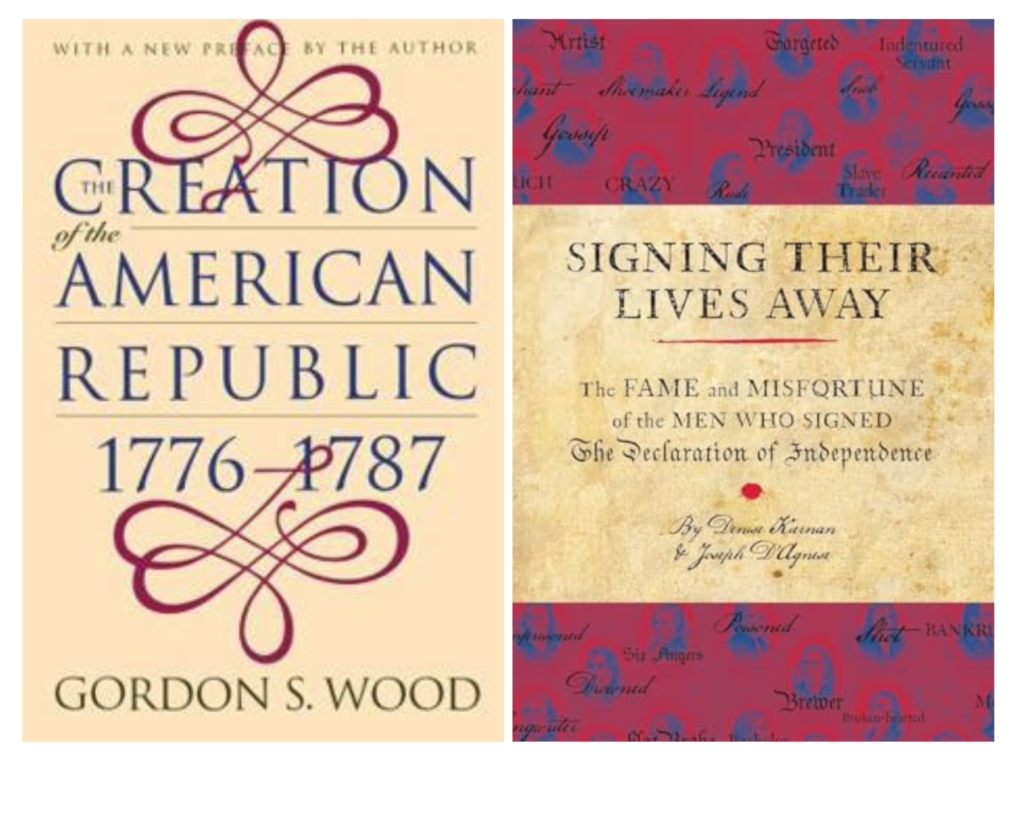
It is sad and deeply ironic that, just weeks from celebrating its 250th anniversary, America lost one of its best and most deeply respected historians of the Revolutionary era,
Pulitzer-prize winner Gordon S. Wood. He died at the age of 92 when he was struck by a car in a supermarket parking lot.
Wood’s book The Creation of the American Republic 1776-1787, is a true classic about our founding, from the Declaration of Independence to the Constitution. Published in 1969, it remains a standard-bearer for understanding the philosophical, political, and social ideas behind America’s founding. It has been on my bookshelf since I was an undergraduate, and I reread it recently.
Wood researched, wrote, and interpreted history by relying on primary sources, and by studying the motivations of the people in their own time period. He never revised or analyzed historical events through a modern-day prism or applied 20- and 21st-century standards to the people and events of 1776-1787.
He believed the American experiment was transformational because it contravened thousands of years of monarchical dominance and brought ordinary people into the political process by establishing a society and culture whose rhetoric and foundation were rooted in liberty, freedom, limited government, natural rights, self-governance by the people, and egalitarianism.
Even when contradictions are apparent – slavery most notably – Wood argued that the ideological principles espoused during the Revolution era provided the moral foundation for all future egalitarian movements, including abolitionism, women’s rights, and civil rights (I agree with this thesis).
Gordon Wood agreed in principle with founder John Adams, who, on the eve of American independence, described what was afoot and what was at stake:
“Objects of the most stupendous magnitude, and measures in which the lives of millions yet unborn are intimately interested, are now before us. We are in the midst of a revolution, the most complete, unexpected, and remarkable, of any in the history of nations.”
If you want to fully grasp John Adams’s words, understand how radical the American Revolution was, and glean the true historical meaning of American exceptionalism, Wood’s classic work (or any of his Revolutionary era books) is a good place to start. RIP Gordon Wood. Great historian and great American.
Version 1.0.0
The other book I reread over the last several weeks was Signing Their Lives Away: The Fame and Misfortune of the Men Who Signed the Declaration of Independence.
In the summer of 1776, fifty-six men risked their lives and livelihood to defy King George III and sign the Declaration of Independence (while the document was approved on July 4, most delegates affixed their signatures on August 2 in a somber signing ceremony at the Pennsylvania State House (now Independence Hall).
It was a treasonous act. The delegates pledged themselves to principles that were antithetical to the Crown, principles best expressed in the Declaration’s iconic second paragraph:
“We hold these truths to be self-evident; that all men are created equal, that they are endowed by their Creator with certain unalienable Rights, that among these are Life, Liberty, and the pursuit of Happiness – That to secure these rights, Governments are instituted among Men, deriving their just powers from the consent of the governed.”
Unalienable rights derived from the Creator rather than the king? Government deriving their powers from the governed? An unheard of notion in 1776; indeed, a Revolutionary one.
This book takes a look at all the signers of the Declaration in a series of short essays – who they were, what they risked, how they and their families were treated, the sacrifices they were willing to make. Some prospered and rose to the highest levels of U.S. government (John Adams and Thomas Jefferson among them), while others had their homes and farms seized by British soldiers. Some are household names (add Benjamin Franklin and John Hancock to Adams and Jefferson), but most – sadly – have been forgotten.
What better time than our 250th anniversary summer to get to know them better? All of them – though from different backgrounds, geographic regions, economic strata, and with different values – came together to form a new nation, and in so doing, put their lives at risk. If the colonies had not been triumphant in war, these men most assuredly would have been hanged. They were well aware of this. Which is why, at the conclusion of the Declaration, they made a more personal declaration of their own:
“And for the support of this Declaration, with a firm reliance on the protection of Divine Providence, we mutually pledge to each other our Lives, our Fortunes, and our sacred Honor.”
← Back to Highlights