The Rise of an American Metropolis, Boston 1850-1900
The second half of the nineteenth century is, quite simply, a breathtaking period in Boston’s history. Unlike the frustrations of our modern era, in which the notion of accomplishing great things often appears overwhelming or even impossible, Boston distinguished itself between 1850 and 1900 by proving it could tackle and overcome the most arduous of challenges and obstacles with repeated, and often resounding, success.
A City So Grand chronicles this breathtaking period in Boston’s history for the first time. Readers will experience the abolitionist movement of the 1850s, the 35-year engineering and city-planning feat of the Back Bay project, the arrival of the Irish that transformed Boston demographically, the Great Fire of 1872 and the subsequent rebuilding of downtown, Alexander Graham Bell’s invention of the telephone in Boston, and the many contributions Boston made to shaping transportation, including the Great Railroad Jubilee of 1851 and the grand opening of America’s first subway.
These stories and many more paint an extraordinary portrait of a half-century of progress, leadership, and influence that redefined Boston as a world-class city.
Reviews
Excerpts
Discussion Questions
Buy A City So Grand
More
Reviews
Dennis Lehane, Author
“A City So Grand is a book so grand. It’s been quite a while since I’ve read anything — fiction or non-fiction — so enthralling. My only complaint is that it ended.”
The New England Quarterly
Wilfred E. Holton – March 2011
Stephen Puleo, a historian and journalist, sets out to chronicle the half-century-long period of “Boston’s metamorphosis from a large and insulated town to a thriving metropolis that achieved national and international prominence in politics, medicine, education, science, social activism, literature, commerce, and transportation.” He does this in an effective but unusual way, zeroing in on specific incidents in Boston while providing a wealth of information on related national events.
Puleo narrates the abolitionist movement and the Civil War in relation to Boston, the early women’s suffrage movement, and the massive influx of Irish immigrants into the city, where they faced harsh treatment. Other sections of the book focus on changes brought about by transportation innovations like steam railroads, electric streetcars, and the nation’s first subway. Puleo details the new technologies and diverse motivations that led to the massive Back Bay landfill project, touches on the annexation of independent cities and towns as part of metropolitan expansion during this period, and covers the effects of the Great Fire of 1872 and other important events in the later nineteenth century.
Puleo crafts compelling stories to introduce his themes and make his points. For example, the section on abolitionism begins with the gripping tale of radical antislavery activists’ failed attempt to free runaway slave Thomas Sims from jail on Fugitive Slave Law charges in 1851. A description of the furor surrounding the 1851 appointment of Barney McGinniskin as the first Irish-born Boston police officer introduces the chapter on Irish immigrants. Puleo opens his coverage of Boston and the Civil War by relating the saga of the Massachusetts Sixth Regiment, which was attacked by a Baltimore street mob in April 1861 as it rushed southward to become the first Union regiment to defend Washington. Later in the book, Puleo tells the captivating tale of Alexander Graham Bell’s invention of the telephone.
While the chapters are roughly chronological, Puleo includes contextual material at many points. Often he describes the activities of Bostonians on the national scene, adding more depth to the stories. Puleo also pays more attention to Boston’s immigrant groups and working-class interests than to the ruling elites. While high cultural and educational institutions are addressed, they are not emphasized. Overall, Puleo’s book is thorough in its coverage of the period, and readers will likely encounter much new information.
Puleo draws from a wide range of sources for his material, including several recently published books. He does utilize original sources in some instances. Although he employs no footnotes, Puleo provides a good bibliographic essay that discusses the sources he consulted for each chapter.
Stephen Puleo is an excellent writer when he is telling a story. Many riveting episodes are included throughout the book, bringing individuals and events to life for readers. The dramatic narrative about the Minkins case, for instance, clearly portrays the strains among abolitionists over breaking an unjust law. The flow of the overall story falters at some points due to the complexity of the period and the lack of gripping anecdotes.
On some topics, Puleo explores complicated issues adeptly. For example, he portrays the changing and conflicting views of Boston’s Irish-American citizens as their Civil War regiments fought bravely but suffered severe losses. Puleo relates this issue to political matters; many Irish leaders felt that Republicans did not appreciate their soldiers’ sacrifices to the Union cause.
Some sections seem less relevant to the larger history; many of these are intended as bridging elements between chapters. For in- stance, early in the chapter “Filling the Back Bay,” Puleo describes the 1851 introduction of the nation’s first electric fire alarm system in Boston, stating that this accomplishment, among others, made the ambitious landfill project seem possible. Then, still before beginning the story of the Back Bay Project, he includes a page on the founding of the Boston Public Library.
As is probably inevitable when a book covers so much material, there are some minor inaccuracies. In “Filling the Back Bay,” for example, Puleo writes that the 1821 dams in the Back Bay “provided water power for the company’s mills in Watertown, Dorchester Lower Mills, and the Neponset River” (p. 86). Thankfully, such mistakes are not critical because Puleo provides his sources, which can be checked by readers. In addition, some important topics of the period have been overlooked, such as the political transformations that occurred when Irish-Americans replaced English Protestants as the largest population group.
A City So Grand will appeal to a broad range of readers who want to understand Boston’s history during the crucial second half of the nineteenth century. The author contextualizes numerous complex elements in an eminently readable way.
Edward Glaeser – November, 2010
“Puleo rightly revels in Boston’s creativity and contradictions. He proudly, and correctly, points to the city’s accomplishments,” says The New Republic‘s Edward Glaeser in a review of Steve’s fourth book, A City So Grand. “Puleo presents us with an enjoyable catalog of wonders produced by Boston during the period under review.” Read the complete review here: The Urban Miracle.
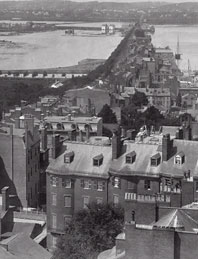
A view of the Back Bay from the State House in the late 1850s, before substantial work had begun on the massive nineteenth-century landfill project. The Mill Dam (which would become Beacon Street) crosses the bay at center. The near shoreline forming a reverse L with the Mill Dam is the site of present-day Arlington Street.<br><em>Photo by Leslie Jones, Courtesy of the Boston Public Library, Print Department</em>
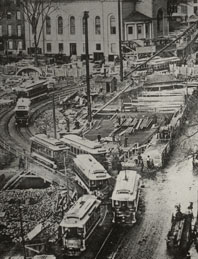
During construction of America’s first subway between 1895-97, above-ground electric-trolley traffic was disrupted along Tremont Street. This photo shows the area near Park and Tremont streets. Note the volume of electric-trolley traffic; congestion on Tremont and Washington streets was one of the arguments subway proponents put forth to justify the project.<br><em>Courtesy of the Boston Public Library, Print Department</em>