The Great Boston Molasses Flood of 1919
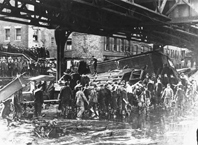
Shortly after noon on January 15, 1919, a 50-foot-tall steel tank filled with 2.3 million gallons of molasses collapsed on Boston’s waterfront, disgorging its contents in a 15-foot-high wave of molasses that traveled at 35 miles per hour. The Great Boston Molasses Flood claimed the lives of 21 people and caused widespread destruction.
For the first time, the story of the flood is told here in its full historical context, from the tank’s construction in 1915 through the multiyear lawsuit that followed the disaster. Dark Tide uses the gripping drama of the flood to examine the sweeping changes brought about by World War I, Prohibition, the anarchist movement, immigration, and the expanding role of big business in society. To understand the flood is to understand America of the early twentieth century – the flood was a microcosm of America, a dramatic event that encapsulated something much bigger, a lens through which to view the major events that shaped a nation.
It’s also a chronicle of the courage of ordinary people, from the firemen caught in an unimaginable catastrophe to the soldier-lawyer who presided over the lawsuit with heroic impartiality.
First published in 2003, Dark Tide continues to capture the imagination of readers across the country and is the only adult nonfiction book on America’s most unusual tragedy.
Reviews
Excerpts
Discussion Questions
Buy Dark Tide
More
Reviews
- “A good sense of timing and an easy voice” From Kirkus Reviews
- “Superb characterizations … enthusiastically recommended” From NewPages.com
- “Thoroughly researched …. weaves together stories of the people and families” From The Associated Press
- “The definitive account of America’s most fascinating and surreal disaster.” From the San Francisco Bay Guardian
- “Giving a human face to tragedy is part of the brilliance” From The Boston Sunday Globe
- “Everything you want in a work of history” James O’Toole, author of Passing for White: Race, Religion, and the Healy Family, 1820–1920
- “A must-read for anyone interested in Boston history” Thomas H. O’Connor, author of The Hub: Boston Past and Present
“A good sense of timing and an easy voice”
From Kirkus Reviews
Boston native and journalist Puleo takes an incident that seems to belong in a Marx Brothers movie and resituates it in the city’s social history. The 15-foot-high wall of molasses that inundated the streets of Boston’s North End in winter of 1919, the debut author explains, flows into such issues of the day as “immigration, anarchists, World War I, Prohibition, the relationship between labor and Big Business, and between the people and their government.” With a good sense of timing and an easy voice, Puleo sets the scene for the disaster to come: the rush to complete a giant tank holding more than two million gallons of molasses, the failure to have it properly tested, the blind eye that parent company US Industrial Alcohol turned to the tank’s copious leaks, and the threats it levied at workers who complained. The author also paints the period’s social picture. Discrimination against the North End’s Italian-born residents and their lack of political participation, whether barred from it or of their own volition, were important factors in the tank’s placement near their neighborhood. The rise of the anarchist movement and its strong antiwar sentiments made the tank a tempting target, since alcohol produced from the molasses went into the making of wartime munitions. The sheer destructive force of the molasses flood is jarringly presented in a number of vignettes about those trapped; 21 people died. In the ensuing court battle, Big Business was put on notice that it would not be trusted to police construction safety standards itself, it was not above the law, and it would be liable for damages. Properly and compellingly recasts quaint folklore as a tragedy with important ramifications.
“Superb characterizations” “Enthusiastically recommended”
From NewPages.com
Tim Davis
You see the evocative title, Dark Tide, and you speculate on the possibilities: gothic horror? detective story? murder mystery? Then you see the subtitle, The Great Boston Molasses Flood of 1919, and you suspect some other possibility: parody? urban legend? But do not allow yourself to misread the subtitle. Instead trust your first impressions because the title is the thematic key: Stephen Puleo’s intriguing book is, in fact, the powerful (and remarkably true) story of a bizarre, tragic incident in Boston’s history.
Dark Tide begins as the World War I era story of U.S. Industrial Alcohol, a company frantically involved in acquisition and waterfront storage of molasses, and then converting that molasses in nearby distilleries into industrial-grade alcohol destined for use in manufacturing munitions for the war effort. Focusing almost exclusively on production efficiency, however, USIA has little time for safety and security at its North End storage facility.
But after the war, on January 15, 1919, something horrible happens: a steel tank (of questionable structural design and integrity) catastrophically fails, and 2.3 million gallons of molasses—in a tidal wave of destruction—floods into the streets, homes, and lives of the North End. When officials complete rescue operations, and when they assess damages, they discover that the Great Boston Molasses Flood has killed more than 20 people and scores of animals, has injured 150 other people, and has left mind-boggling destruction in its wide wake.
Puleo, in the first half of Dark Tide, presents a thorough history about what led up to the January incident. In the second half, Puleo describes the disaster itself and then turns the book into a compelling detective story about who was responsible: USIA? employees? terrorists? anarchists? immigrants? The incident later becomes the subject of a multiyear lawsuit wherein responsibility is assigned and liability assessed, and Puleo painstakingly documents and analyzes the successes and failures of the case.
The exceptional strength of Puleo’s singular book comes through most notably, however, in his superb characterizations of the people involved in the incident and its aftermath. Corporate managers, government officials, court advocates, and the extraordinary citizens of the devastated North End—those people who were immediately and horribly affected by the tragedy—come to life in this enthusiastically recommended, important regional history.
“Thoroughly researched … weaves together the stories of the people and families”
From The Associated Press
Randolph E. Schmid
It’s an idea so bizarre as to be unbelievable, a massive flood of molasses — in January — sweeping all before it, crushing buildings, engulfing people and horses, battering railway tracks.
Yet it happened, claiming 21 lives in the process, with the collapse of a giant tank containing 2.3 million gallons of the syrup on the Boston waterfront. Twenty-one people died, others suffered permanent injury or were left homeless in the wake of the tragedy.
In Dark Tide: The Great Boston Molasses Flood of 1919, journalist Stephen Puleo details what happened in this first book on the subject.
Thoroughly researched, the volume weaves together the stories of the people and families affected by the disaster, with often heartbreaking glimpses of their fates. Puleo sets the scene carefully, in the context of the time and social conditions, and follows through with the years of lawsuits that ensued.
It had been a boom time for United States Industrial Alcohol, manufacturer of alcohol used in munitions during World War I. But the war was over and Prohibition was looming, cutting the market for alcohol. Hoping for one last big market, the company had filled its giant tank with molasses, planning to distill it into drinking spirits to sell before the ban on alcohol took effect the following year.
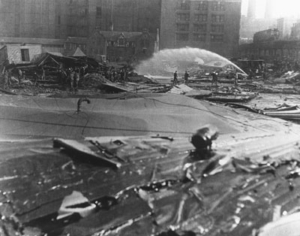
Then, shortly after noon on Jan. 15, 1919, the 50-foot-tall tank, hastily built four years earlier, gave way, sending millions of gallons of molasses in a massive wave sweeping across the docks, demolishing a home and fire station, and even bending an elevated railway structure.
Martin Clougherty, who worked the night shift, was asleep when the molasses demolished his house. “He had had the sensation of falling overboard, had felt his head go under, and it was only then — when the liquid rushed into his nose and mouth, when he could taste it — that he realized he was immersed in molasses,” Puleo reports.
Clougherty was able to save himself and pull his sister to safety. But his mother was fatally crushed in the collapsing building. His brother Stephen died a year later in a mental hospital.
Stonecutter John Barry was trapped in the demolished city street repair building, others moaning around him. Repeatedly during the day, rescue workers had to crawl to him through the muck and inject morphine to ease his pain until they could get him out.
Giuseppe Iantosca was standing at his apartment window watching his son, Pasquale, gather firewood around the base of the tank when the little boy suddenly disappeared in the dark mass. Iantosca searched for hours before returning to his wife Maria.
“Exhausted and disconsolate, he trudged up the dark stairs and stepped into the house. Maria was waiting for him, her black eyes rimmed red from crying. Neither of them spoke — he had come home alone, and that said everything.”
The boy’s body was recovered days later.
The cleanup lasted months, the lawsuits years, the fearful memories a lifetime.
“The definitive account of America’s most fascinating and surreal disaster”
From the San Francisco Bay Guardian
John Marr
Stephen Puleo’s Dark Tide vividly tells the full story of this classic catastrophe for the first time. There is no shortage of inspired eyewitness testimony on the awesome power of unleashed molasses and dramatic stories of rescue and survival. Melodramatic, true, but how can a molasses flood be anything else? One lucky fellow survived by treading molasses.
Dark Tide does put the flood in its surprisingly important historical context — ultimately, it did for building permits what the Coconut Grove fire did for fire codes 23 years later. But even the lengthy legal proceedings are absorbing, thanks to the tank owners’ absurd attempts to pin the blame for their own incompetence on bomb-toting Italian anarchists. Dark Tide is the definitive account of America’s most fascinating and surreal disaster.
“Giving a human face to tragedy is part of the brilliance”
From The Boston Sunday Globe
Caroline Leavitt
Ordinary people, extraordinary disasters: The wrath of fire and flood
Shortly after 9/11, The New York Times began running thumbnail sketches and photos of the dead. These were ordinary people, and the things written about them were pretty everyday as well. One father was remembered for acting out bedtime stories to his son; a woman was famous for her tuna salad. In the common humanity of the details, these people stopped being part of a huge number of casualties, and instead each person became a unique loss. And because of that, the tragedy was all the more indelible.
Giving a human face to tragedy is part of the brilliance of Stephen Puleo’s Dark Tide: The Great Boston Molasses Flood of 1919. I’m Boston-born and -bred, but I’d never heard of this cartoony-sounding disaster, which was anything but comic. On Jan. 15, 1919, in Boston’s North End, a neighborhood crowded with Italian immigrants, a 50-foot-tall steel tank, loaded with over 2 million gallons of molasses (the industrial kind used for World War I munitions) collapsed, shooting out deadly steel missiles. Twenty-five-foot tidal waves of molasses, traveling at 35 miles per hour, engulfed the nearby neighborhood, causing massive destruction, killing 21 people, and injuring more than 150. Why did such a flood fade into folklore, remembered only in a few children’s storybooks?
Puleo believes it’s because the flood was never put into proper historical context, and using newspaper accounts, fire department files, and court records, he painstakingly recrafts the tale. But, for me, what really brings this story into terrifying focus are the individual people Puleo lets us get to know.
There’s Arthur P. Jell, US Industrial Alcohol’s overseer, who had the tank built in the midst of a busy immigrant neighborhood because it was an easier way to meet production quotas, a man who addressed local unease about the leaking tank by painting it molasses-brown to hide the seepage. There’s company man Isaac Gonzales, whose nightmares about the tank collapsing had him running through Boston for a frantic middle-of-the-night check. There’s John Barry, a stonecutter who survived the flood, his dark hair shocked white overnight. And there’s the molasses tank itself, prompting Gonzales to claim, ”The giant steel container was alive and he was hearing the low growl of a hungry animal.”
Who was to blame for the disaster? There were 119 separate legal claims against USIA, but outrageously, a judge blamed the public for not insisting that the best people be put on the job. USIA accused antiwar anarchists of bombing the tank, an argument fueled by the Sacco and Vanzetti trial. But there was no physical evidence of bombing, and after a grueling, 10-year trial, USIA was found guilty, held accountable for not hiring qualified people to oversee the operation.
After the trial, anarchy (and the perceived threat from it) pretty much died. More Italian immigrants became citizens, claiming some power for themselves. But until they were given voice in this book, the characters who drove the story were forgotten.
“Everything you want in a work of history”
James O’Toole, author of Passing for White: Race, Religion, and the Healy Family, 1820–1920
Why has no one ever told this story before? The Boston molasses flood lives dimly in popular memory, but no historian has explored it fully until now. The results of Stephen Puleo’s labors combine exhaustive research, shrewd analysis, careful placement in local and national context, and an ability to tell a good tale — everything you want in a work of history.
“A must-read for anyone interested in Boston history”
Thomas H. O’Connor, author of The Hub: Boston Past and Present
The great molasses disaster of 1919 in Boston’s North End provided a dramatic prelude to a new era in post–World War I America. Stephen Puleo brings it to life with vivid prose, using the dreadful catastrophe as a lens through which to view the panorama of a changing Boston, as well as to survey the major events that would shape the future of twentieth-century America. This is a must-read for anyone interested in Boston history.

For the first time, the story of the flood is told here in its full historical context, from the tank's construction in 1915 through the multiyear lawsuit that followed the disaster.