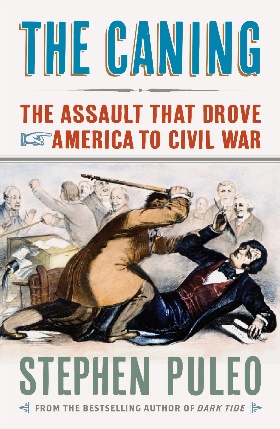
The Assault That Drove America to Civil War
Early in the afternoon of May 22, 1856, ardent pro-slavery Congressman Preston S. Brooks of South Carolina strode into the United States Senate Chamber in Washington, D.C., and began beating renowned anti-slavery Senator Charles Sumner with a gold-topped walking cane. Brooks struck again and again—more than thirty times across Sumner’s head, face, and shoulders—until his cane splintered into pieces and the helpless Massachusetts senator, having nearly wrenched his desk from its fixed base, lay unconscious and covered in blood. It was a retaliatory attack. Forty-eight hours earlier, Sumner had concluded a speech on the Senate floor that had spanned two days, during which he vilified Southern slaveowners for violence occurring in Kansas.
Brooks not only shattered his cane during the beating, but also destroyed any pretense of civility between North and South. One of the most shocking and provocative events in American history, the caning convinced each side that the gulf between them was unbridgeable and that they could no longer discuss their vast differences of opinion regarding slavery on any reasonable level. The Caning: The Assault That Drove America to Civil War tells the incredible story of this transformative event. While Sumner eventually recovered after a lengthy convalescence, compromise had suffered a mortal blow. Moderate voices were drowned out completely; extremist views accelerated, became intractable, and locked both sides on a tragic collision course.
The caning had an enormous impact on the events that followed over the next four years: the meteoric rise of the Republican Party and Abraham Lincoln; the Dred Scott decision; the increasing militancy of abolitionists, notably John Brown’s actions; and the secession of the Southern states and the founding of the Confederacy. As a result of the caning, the country was pushed, inexorably and unstoppably, to war. Many factors conspired to cause the Civil War, but it was the caning that made conflict and disunion unavoidable five years later.
Review
Excerpts
Discussion Questions
Buy The Caning
More
Reviews
Russell S. Bonds, author of War Like the Thunderbolt: The Battle and Burning of Atlanta
Preston Brooks’s notorious beating of Charles Sumner on the floor of the United States Senate perfectly encapsulates the politics, passions and prejudices that ignited the Civil War. Stephen Puleo’s beautifully written, compelling account of the caning and its aftermath presents the often-overlooked drama of the late 1850’s, illuminating a cast of fascinating characters — not only Brooks and Sumner, but Stephen Douglas, John Brown, and Abraham Lincoln — just as they step from the wings onto the great stage of history. The Caning is an engrossing story of violence made more resonant by our awareness of the bloodbath still to come, and essential reading for anyone who wants to understand the Civil War and its causes.
The Boston Globe
Kate Tuttle – November 3, 2012
In 1856, when South Carolina congressman Preston Brooks brought his cane down upon the head of Charles Sumner, senator from Massachusetts, he beat Sumner so hard the cane splintered. According to Stephen Puleo, the assault on the Senate floor— and especially the radically different reactions to it in the North and the South — triggered a chain of events leading straight to the Civil War. The country had debated the role of slavery for nearly a century, but the caning heightened already intense disagreements, especially over the status of new states such as Kansas, which was the primary battleground before the war began. After Brooks’s attack, northern newspapers decried its brutality, seeing it as an insult to free speech and indication of southern barbarism, while many in the South applauded. “Hit him again,” editorialized Brooks’s hometown paper.
Puleo tells the story vividly, masterfully distilling its sprawling context. Yet at times he seems curiously tone deaf, repeatedly extolling the virtues of compromise when, of course, slavery is an issue about which compromise is impossible. He’s at his best when chronicling the lives of the two men at the heart of the caning. Infamously prickly and intense, the fiery abolitionist Sumner was, according to a friend, “almost impervious to a joke”; still, his steadfast devotion to principle commands respect. For his part, Brooks had been infuriated by Sumner’s recently delivered speech about the turmoil in “Bleeding Kansas,” in which he had insulted Brooks’s cousin, Senator Andrew Butler of South Carolina. Brooks limped from an earlier duel wound; the code duello (literally rules for duels) was just one part, Puleo writes, of “a code of honor that governed virtually every aspect of a white Southern gentleman’s life.” One country, two civilizations.
Fredricksburg Star
Elizabeth Rabin – October 28, 2012
On May 22, 1856, Preston Brooks, a congressman from South Carolina, beat Charles Sumner, a senator from Boston, in the Senate chamber with a malacca cane. Time and distance makes this statement now sound like an accusation from the game Clue. But in the years before the Civil War, Brooks’ act signaled the widening distance developing in contemporary American society.
Abolitionist rhetoric and pro-slavery response had led from fiery words to physical violence that spread even to the halls of American government. Stephen Puleo’s latest nonfiction book, The Caning: The Assault That Drove America to Civil War, focuses on the confrontation between Brooks and Sumner and explores the events that led up to it.
Puleo’s book is an accessible, interesting read for those who are curious about the Civil War but may be intimidated about where to start.
Sumner was a Boston native who fought what he thought was the good fight against slavery by using the most inflammatory remarks at his disposal. Brooks was a young Southern man determined to avenge what he felt were personal insults toward his land and his family, even if it meant violence.
Readers will not only find The Caning a compelling read, but they may be surprised to find multiple parallels to today’s political climate. The debate over the legality of slavery often hinged on what was or wasn’t explicitly spelled out in the Constitution, much like many hotly debated issues today. Many editorials of the day insisted that “apathy was not an option . . . nor were insipid calls for calm, reason or cooler heads.” Again and again, citizens from both pro-slavery and abolitionist states emphasized how they were incapable of even understanding their opponents’ arguments.
As our current political discussion continues to be stormy, these same sentiments come up whether the issue is health care or the federal deficit.
With attitudes like these in 1856, violence, not just between statesmen, but between American citizens was inevitable. The time for talk was over; many illustrations of the caning acknowledged this by showing Brooks’ cane overcoming Sumner’s pen. While The Caning may be a jumping-off point for history buffs in the making, the book is also a grim reminder of what can happen when a healthy debate becomes a polarizing argument that neither side is willing to lose.
Barnesandnoblereview.com
Paul Di Filippo – November 23, 2012
The famous but vaguely recalled historical incident is generally referenced whenever a commentator wishes to indicate the depths of internecine strife to which the United States once descended, and which the country is possibly in danger of reaching again. Typically, we hear, “Divisive as things are today on the political scene, they can’t compare to the days just prior to the Civil War, when one politician actually beat up another on the floor of the Senate.” Then the argument moves on, with the rhetorical touchstone having been lightly and carelessly stroked.
But behind all such bland, automatic, and generic references lies an absolutely fascinating and complex story, full of rich specifics. Author Stephen Puleo has invested a huge amount of intelligent research into the matter — the events surrounding and including the moment on May 22, 1856, when Congressman Preston Brooks of South Carolina thrashed Senator Charles Sumner of Massachusetts with a gold-topped wooden cane on the floor of Congress — and he has cast the facts into The Caning, a compulsively readable narrative which does honorable, evenhanded justice to all the players and issues of the era, while teasing out not only similarities with our present antagonistic politics but also some educational differences.
Part I of Puleo’s story succinctly and cogently establishes the national conditions and political currents leading up to the public beating. Currently at the center of the burgeoning anti-slavery debate was the state of Kansas, recently deemed acceptable to host slavery by no less an authority than President Franklin Pierce. Several famous cases of runaway slaves restored to their owners also inflamed feelings on both sides of the issue. Senator Sumner, dogmatically abolitionist, chose to deliver a two-day, multi-hour speech ranting against the Kansas decision and many other topics, in which he gratuitously insulted his colleague, Senator Butler of South Carolina. Here we pause dramatically to flash back to the birth of Sumner and the familial and personal characteristics that shaped him into an emotionally constricted yet principled ideologue.
Part II brings us up to the cliffhanger moment of the caning, and also focuses on Preston Brooks, the antagonist, revealing with lucid details the antithetical societal and cultural forces that shaped the Southern partisan, a man for whom, unlike his opponent, family and honor outweighed everything.
Part III opens with the central Chapter Eleven, “The Caning,” a mighty tour-de-force of vivid reenactment. The reader feels a tingling “you are there” set of thrills. This section continues with the incredibly complicated aftermath and fallout of the assault, which was taken up by both Northerners and Southerners as an emblematic torch for their respective causes. From the vigilante actions of John Brown to the dignified yet fervent speeches of Lincoln, Sumner and Brooks served as irreplaceable talismans and goads to action. This section climaxes with the untimely death of Brooks from an infection, followed by his cis-Mason-Dixon canonization.
Part IV traces the widening ripples of the altercation, from its impact on the Supreme Court’s Dred Scott decision (“perhaps the most controversial American judicial decision in history”), through John Brown’s Harpers Ferry raid and Lincoln’s election. Along the way we get the heroic and pathetic return of a still debilitated Sumner, four years after his caning, to the Senate for a final rabble-rousing speech. Puleo caps everything off with an account of Sumner’s death in 1874 — an era intimately connected with 1856 yet incredibly distant too — and an assessment of how history has treated each principal in the battle.
The elements of this tale that pertain directly to the concerns of 2012 are myriad and vital, rendering this book an important lesson as well as an entertaining excursion to the past. The way that even a noble cause like abolition can be seduced into supporting outlaw actions such as those of John Brown. The role of the media in stoking the fires of contention. (Puleo lists a mere sampling of the dozens of newspapers he surveyed.) The impact of bias confirmation in determining our political stances. The divergent roles of high-minded and demagogic politicians. So many similarities both inspire and cause despair at how little has changed in human nature.
The strangenesses of this era are the other side of the coin. For one thing, Puleo’s account make these actors and their causes seem positively Shakespearean compared to our own times. I don’t think it’s mere distance that elevates the discourse and stakes. I just can’t fathom anyone one hundred years from now writing an equally lofty and tragic tome about the 2012 elections. Nor is it completely possible to compare Springsteen to Longfellow, or Jon Stewart to Ralph Waldo Emerson. And, in a trivial but gratifying manner, the reader also encounters many quaint and charming tokens of the past. Jefferson Davis addressing the citizens of Boston from the balcony of Faneuil Hall?! I particularly liked the tribute offered to Sumner by the inmates of the Boston Female Orphan Asylum, “where young girls were lined up in front of the building waving handkerchiefs and displaying on a white banner a wreath of evergreen covered with flowers, along with a sign that read: ‘We weave a wreath for Charles Sumner.’” And the loony French doctor who treated Sumner with applications of burning cotton wool along his spine is pure steampunk.
In deftly and charmingly explicating this ancient scandal, Stephen Puleo has simultaneously rescued an important part of America’s heritage while shining a light that helps illuminate our forward path.
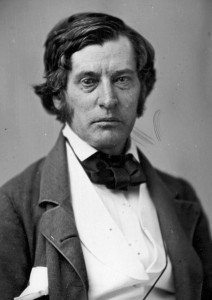
Charles Sumner
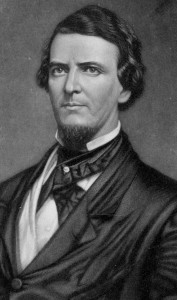
Preston Brooks

One of hundreds of canes Preston Brooks received from supporters after his assault on Charles Sumner. The cane shown here is part of a collection held by the McKissick Museum at the University of South Carolina, Brooks's alma mater.