Announcing Book 9!
I appreciate your patience!
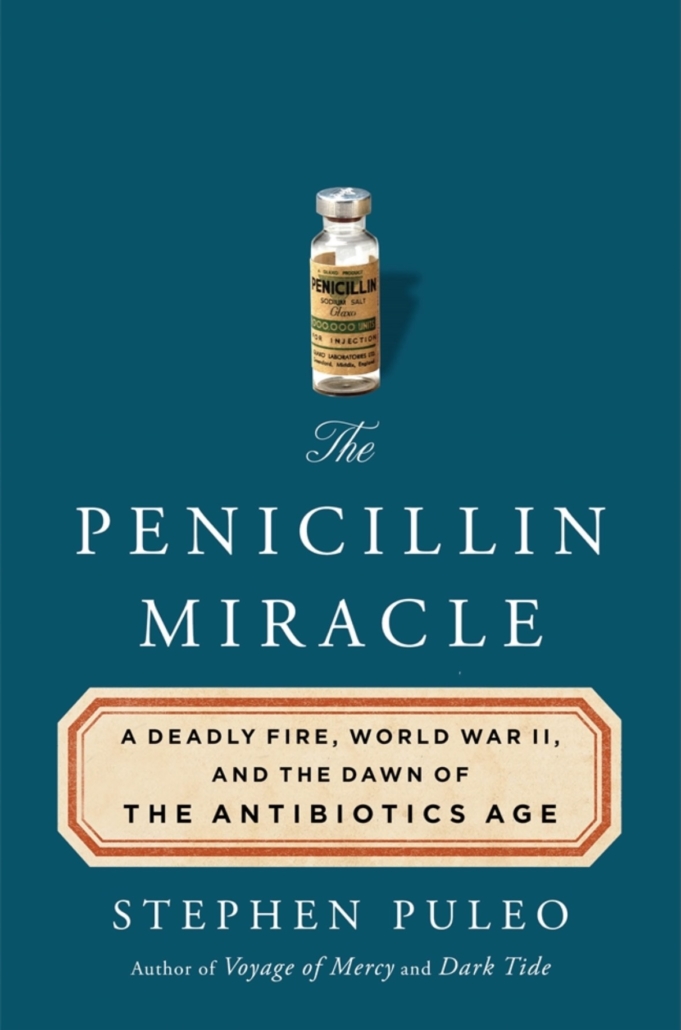
I’m honored to introduce the topic and the cover of my upcoming book (number 9!):
The Penicillin Miracle: A Deadly Fire, World War II, and the Dawn of the Antibiotics Age, to be published by St. Martin’s Press on August 31, 2027!
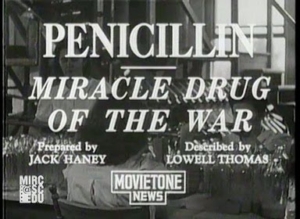
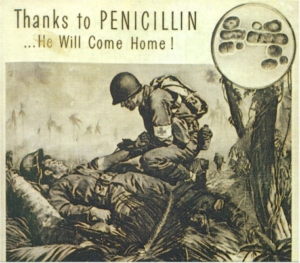
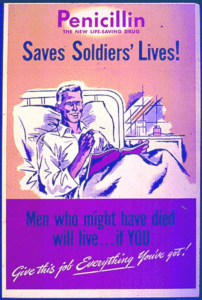
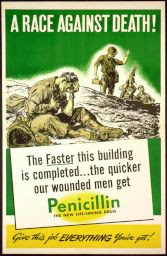
I’m so excited about this book and want to give you a flavor of the story now! The graphics shown at the end of the article are authentic home-front images used during the Second World War, but should not be confused with the book’s cover image.
Coming August 31, 2027!
First – A Few Words About the Cover Image
I think it’s stunning and I hope you agree. Its the ideal blend of old and new – contemporary and elegant on the one hand, and retro and with a clear WWII feel on the other.
I’m so impressed with the beautiful look and the sleek and uncluttered feel of the jacket. The WWII battlefield penicillin vial standing alone at the top gives you a feeling of starkness, and at the same time, conveys importance for the topic – and also lets the reader know that this is a work of history with a medical component, not a “medical” book. The subtitle, which resembles the label on the penicillin vial, also reinforces this. And the type font on both the title and the subhead really pop.
Finally, I couldn’t be happier with the rich and dramatic shade of blue – I think this beautiful image will stand out at bookstores and signing events, as well as online. Let me know what you think and please start spreading the word about The Penicillin Miracle!
Read on and enjoy!
One of the Most Compelling Stories Ever –
The Medical “Manhattan Project”
Few stories in all of the twentieth century, or any century, are as compelling as the cultivation, isolation, purification, stabilization, testing, mass production, and widespread distribution of penicillin during World War II – the equivalent of a “medical Manhattan Project,” in the words of one U.S. government official. While most Americans are at least partially familiar with the secret effort that produced the atomic bombs, few are aware of its public health equivalent – the “penicillin miracle” that produced the new “wonder drug,” as it was called repeatedly in the 1940s.
This herculean project occurred at lightning speed and with unprecedented cooperation between British (Oxford) and U.S. researchers and among the U.S. government, pharmaceutical companies, universities, and medical professionals working across numerous geographic locations – Oxford, Washington, D.C., Boston, Brooklyn, and Peoria, Illinois, among others.
Its success reshaped the world in the battle against fatal and debilitating infections, first from disease and war wounds suffered by U.S. and Allied soldiers, and then from injuries and illnesses that beset civilians in the U.S. and overseas.
The Penicillin Miracle and World War II
Were Inextricably Intertwined!
Like so many major scientific and technological breakthroughs and social upheavals of the 1940s – the splitting of the atom, the invention of radar and sonar, the massive movement of women into the workplace, the creation of the computer and defense industries, the birth of intelligence agencies – the full penicillin story was driven by the Second World War and how the Allies could win it.
Penicillin research was not launched because of the war, but the war drove decision-making and provided the rationale for virtually every critical decision made about penicillin along the way.
World War II and penicillin were inextricably intertwined. Without the war, the penicillin miracle, which was fulfilled in the United States, may have remained the penicillin mystery for years to come, and could have delayed for decades the antibiotics age. Only when sufficient penicillin was produced to meet the military’s needs did U.S. civilians – who made hundreds of requests to the government for the new drug – have full access to its curative capabilities.
The Full “Miracle” Occurs Between 1942 (almost zero penicillin) and
D-Day, June 6, 1944 (enough penicillin to supply every Allied
soldier who went ashore at Normandy)
Set in England and the U.S., and based on numerous archival sources, The Penicillin Miracle for the first time tells the full political, scientific, and social story behind the most important medical breakthrough of the twentieth century, set against the backdrop of world war. This includes the oft-ignored chapters of how penicillin captured the imagination of the American people, who desperately sought the wonder drug even as government authorities designated the vast majority of the medicine for military use in 1942, 1943, and much of 1944.
Penicillin burst upon the American and world scene with blazing speed, and just when Allied soldiers and civilians needed it most.
In early 1942 – two years after Oxford researchers had proven penicillin’s effectiveness in mice – there was not enough penicillin in the United States to adequately treat even a single patient. In late 1942, Dr. Champ Lyons of the Massachusetts General Hospital used almost all the available penicillin in the country on a small group of burn patients, victims of the historic and deadly Cocoanut Grove nightclub fire – the first-ever use of penicillin on a controlled group of patients who suffered infections from their burns.
Yet by early 1943, the first group of wounded U.S. troops returning from the battle of Guadalcanal in the Pacific were treated with penicillin, though supplies were not sufficient enough to treat wounded soldiers at the battlefront. By fall, however, U.S. troops wounded in North Africa were treated in-theater with the drug. As the June, 1944 D-Day invasion of Europe crept closer, a full-on effort – overseen by the United States government, and including scores of private researchers, university scientists, physicians, the medical establishment, and nearly two dozen large drug companies – kicked into high gear to produce and distribute enough penicillin to treat all the Allied wounded, curing once fatal battlefield infections, and saving tens of thousands of lives.
By 1945, when my father was wounded – penicillin likely saved his life, or at the very least, spared him from disabling injuries – the “wonder drug” was so abundant that the government made it available for widespread civilian use in America and was exporting it to Allies abroad.
An Inspirational Story of a World-Altering Scientific and
Medical Breakthrough Pinned Against the Vast Tapestry of World War
As is the case with most epochal stories, The Penicillin Miracle encompasses the best of human behavior – dedication, selflessness, strong leadership, and nobleness of purpose among people of extraordinary talent – coupled with an occasional sprinkling of the worst: pettiness, jealousy, stubbornness, and egotism.
Overall, though, it is an inspirational story, one of courageous collaboration, of audacious risk-taking, of science and art; all for the sake of the public good and all pinned against the vast tapestry of world war.
The penicillin miracle in the 1940s eased the suffering and saved the lives and limbs of several hundred thousand Allied soldiers, offered hope to civilians everywhere, and ushered in a new age in medicine that would become known as the antibiotics revolution – a world-altering transformation that, during the last 80 years, has saved an estimated 500 million lives across the globe.
I Think You’ll Love the Book!
I feel like I know most of you personally. Many of you have written to me about my books, talked to me at presentations, and posted comments online. I feel confident in saying that I truly think you’ll love The Penicillin Miracle narrative. I truly enjoyed researching and writing it – all the while keeping you in mind!!
During the run up to the release, I’ll be providing you with more information and snippets about The Penicillin Miracle on social media accounts and in The Speakeasy platform on my website (keep your eyes peeled for a cover image). My next newsletter in the Fall will also include additional info!
Reminder: To sign up for The Speakeasy, just go here and put in your email and select a password (If you receive my emailed newsletter, you’ve already shared your email with me – thanks for that; any password you choose remains confidential to you. That’s how simple it is). Once you’ve entered The Speakeasy, you’ll see topic area tiles labeled “Books,” “History,” “Medley” and “Ask Me Anything.” You’ll see posts from me, and you can post your comments accordingly.